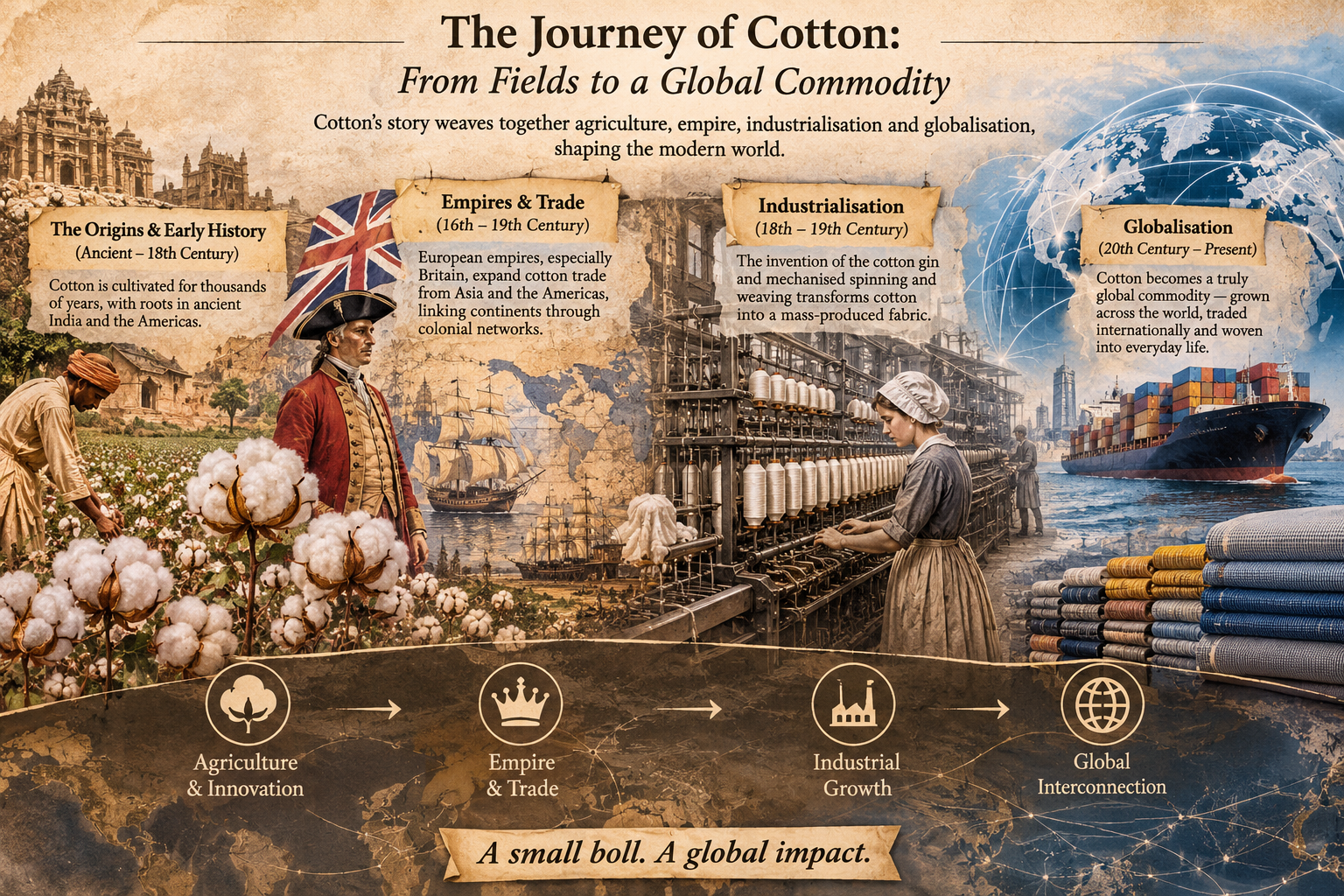
' The Pivotal Role of Indian Cotton in Shaping Globalisation and Industrialisation’
The Pivotal Role of Indian Cotton in Shaping Globalisation and Industrialisation
By Chy Shahin (21 December 2025)
chyshahin@yahoo.co.uk @PublicHistoryGlobal.info
INTRODUCTION
Indian cotton has played a crucial role in shaping global trade and the modern world we live in today. This soft, versatile fabric has not only been a key export product but has also influenced numerous aspects of culture, the economy, and society around the globe. The high Himalayan mountains have formed many rivers in the subcontinent, which flow down to the valleys and meet the Indian Ocean and the Bay of Bengal. The meandering rivers throughout the subcontinent often overflow their banks during the monsoon season. This annual flooding deposits a rich layer of silt and mud in the surrounding areas, significantly increasing the fertility of the arable land on both sides of the rivers. The cultivation of cotton in this terrain produced a high-quality product characterised by softness, durability and comfort.
There were regional variants of cotton products, famous for their intricate weaving. Among those are: Chintz, Calico, Khadi and Muslin, in which Dacca muslin was the most famous and expensive goods. These luxurious materials, produced in the vibrant city of Dhaka (formerly known as Dacca) in present-day Bangladesh, were highly prized for their exceptional softness, intricate patterns, and lightweight quality.
Scholars specialising in the connections between cotton, globalisation, industrialisation, and modernity argue that Indian cotton played a vital role in shaping these aspects from the first millennium onwards. The cultivation and trade of cotton in India not only increased the region's economic prosperity but also fostered cultural exchanges and technological advances. As Indian cotton became increasingly sought after in global markets, it influenced textile production methods worldwide, leading to the rise of empires and laying the groundwork for industrial revolutions in various countries. Although this transformation had a negative impact on the Indian peasants and weavers, this intricate web of links among cotton, empire and colonisation, international trade networks, and industrial development highlights the significance of Indian cotton in understanding the broader historical narrative of modernisation and globalisation.
Indian Cotton, History, Trade, and Globalisation
From the earliest time until well into the nineteenth century-that is, for several millennia-the people of the Indian subcontinent were the world's leading cotton manufacturers. Peasants in what are today India, Pakistan, and Bangladesh cultivated small quantities of cotton alongside their food crops.[1]
The Indian subcontinent has a profound and illustrious history of producing high-quality cotton fabrics, a tradition that has persisted for over 5,000 years. Historical records and archaeological findings suggest that the cultivation and processing of cotton for textile production can be traced back to the Indus Valley Civilisation, which was notable for its advanced agricultural techniques and craftsmanship. This longstanding practice underscores not only the region’s significant cultural evolution but also its vital role in economic development, particularly through trade networks that connected India to the Middle East, Europe, and other regions. Over the centuries, various weaving techniques and stylistic variations have emerged, reflecting the diverse cultural influences and innovations which have contributed to the global reputation of Indian cotton textiles.[2]
Cotton holds significant importance in ancient Indian culture, frequently mentioned in various religious texts, particularly the Vedic scriptures that date back to approximately 1500 to 1200 BCE. These texts, among the oldest sacred writings in Hinduism, highlight the cultural and economic value of cotton. The mentions often relate to its use in garments and rituals, indicating its role in daily life and spiritual practices.[3] The earliest archaeological evidence of spinning and weaving cotton has been uncovered in the Indus Valley, particularly at the ancient site of Mohenjo-Daro. This significant finding indicates that these textile practices likely took place between 3250 and 2750 BCE. Notably, Mohenjo-Daro was one of the largest cities of the Indus Valley Civilisation, showcasing an advanced urban planning system and a thriving economy. The discovery of cotton fibres, along with spindle whorls and loom weights, suggests that cotton was not only cultivated but also expertly processed into fabric, highlighting the technological sophistication and cultural importance of textile production in this early society.[4] This historical context shows that agricultural communities in the Indian subcontinent have cultivated cotton alongside food crops since ancient times, underscoring the interdependence of agricultural and textile production in this region's economic landscape.[5] In the early second millennium, India established a highly advanced regional cotton industry renowned for its craftsmanship and innovation. This industry produced a diverse range of cotton fabrics, including premium varieties such as muslin, which were highly sought after for their fine texture and quality. The fabrics were tailored to meet the needs of domestic markets and were also exported extensively across the Indian Ocean. Trade routes facilitated the exchange of these textiles with regions such as the Middle East, where they were prized by local merchants, and East Africa, where Indian cotton facilitated cultural exchanges and commerce.
Moreover, Southeast Asia became a significant market for these textiles, further enhancing India's reputation as a leader in cotton production and trade during this period.[6] Even Herodotus, often referred to as the father of historical writing, made noteworthy references to Indian cotton in his chronicle, "Histories." In his accounts, he described the cultivation and use of this fabric, highlighting its significance to trade and culture in ancient India. Ramon's studies support the claim that Indian cotton and cotton-related fabrics have been consumed in various regions since ancient times. Raman mentioned that Herodotus, the father of historical writing, wrote in his chronicle around 450 BCE about the Indians' knowledge of cotton fabric.[7] McLaughlin’s research showed that muslins were traded in the classical era throughout the Greek regions. The author of Periplus of the Erythraean Sea mentioned in his writing between 40 and 50 CE that a country with a river called the Ganges produced fine Muslins and had a trade relationship with the ‘Chryse’ Greek region.[8]
Parthasarathi emphasised the critical role of communication systems in the Indian Ocean, highlighting their impact on trade and connectivity. He elaborated on how an intricate network of local canals and rivers serves as vital conduits that link inland regions to the expansive waters of the Indian Ocean. These waterways not only facilitate the movement of goods but also intersect with historical trade routes such as the Silk Road. This strategic connection enhances the efficiency of trading in valuable commodities such as cotton and muslin, making it easier for merchants to transport their goods to broader markets. By leveraging these natural routes, traders could maximise the flow of resources and cultural exchange, ultimately shaping the region's economic landscape.[9] This acknowledgement not only highlights the significance of Indian cotton in ancient times but also demonstrates the early globalisation of trade and the complex networks of cultural exchange that extended beyond the Silk Road.
From 1000 to 1900 CE, cotton was the most significant economic sector globally. Cotton consumption was ubiquitous across all industries.[10] This period, cotton emerged as the most significant economic sector worldwide, playing a crucial role in shaping trade and industry. Its cultivation and processing became integral to the economies of many countries, especially in regions such as India, Egypt, Europe and eventually the United States. Indian Cotton consumption was widespread, affecting a multitude of industries, including textiles, clothing, and even home furnishings. Long before modern technology was invented, Indian cotton was a ‘global mass consumer good’, traded in East Africa in the eleventh century, most regions of Asia, and from 1650 to Europe, the Middle East, and the Mediterranean areas.[11] These textile industries thrived throughout Asia, captivating artisans and consumers with their vibrant colours and intricate patterns.
Beginning in 1650, Indian cotton entered European markets, as well as the Middle East and the Mediterranean. This significantly influenced trade networks and cultural exchanges. The high demand for this commodity not only emphasised its economic importance but also highlighted its impact on global trade dynamics during that period.
Around 1800, the Indian subcontinent emerged as the world's most significant cotton-manufacturing region.[12] India's rich agricultural resources and traditional weaving techniques have significantly contributed to its textile industry. The fertile plains of the Ganges and the extensive labour provided by local artisans facilitated the production of high-quality cotton textiles, which gained popularity both domestically and internationally. Major centres of cotton production, such as Bengal and Gujarat, thrived as they established robust trade networks that extended to Europe and beyond. This period marked a pivotal moment in the global textile industry, as Indian fabrics became highly sought after for their intricate designs and superior craftsmanship, laying the groundwork for the future of cotton manufacturing worldwide. Cotton emerged as the first truly globalised commodity in the modern world, playing a pivotal role in international trade and the global economy.[13] As mentioned, Indian cotton accounted for a significant share of international cotton production even before the modern era. In Indian cotton production, semi-mechanised wooden tools were used, and embodied knowledge was crucial for performing tasks effectively and efficiently.
Globalisation and Indian Cotton
Beckert correlated Indian cotton with globalised commodification, globalisation, the great wars, colonisation, technological innovation, divergence, and the ubiquitous use of cotton in the world before European economic expansion.[14] Frank Trentmann, a leading scholar of the history of consumption, wrote that cotton was a ‘truly global mass consumer good’.[15]
As noted above, the school of globalisation and commodity in history unanimously acknowledges that cotton, especially Indian cotton, was the first truly globalised commodity traded across all world regions since ancient times, and its cultivation and production were documented from the Indus Valley archaeological site as early as 2500 BCE. In the early seventeenth century, India was a remarkably advanced nation in terms of production and trade, with extensive global connections that facilitated commerce across continents. Boasting one-fifth of the world's population, India was not only home to a diverse array of cultures and languages, but it also played a crucial role in the global economy. During this period, the subcontinent produced approximately one-quarter of the world's industrial goods, particularly textiles, showcasing its skilled craftsmanship. India was the world leader in cotton fabrics, recognised for their quality and variety, which were highly sought after in international markets.[16] This vibrant trade network linked India to key regions such as Europe, the Middle East, and Southeast Asia, positioning it as a central hub in the early modern global economy. Traders and merchants from across the globe flock to India in search of profitable opportunities, aiming to enrich themselves, their shareholders, and their home countries. By the late seventeenth century, Europeans had established trading posts in key regions of India. This influx of foreign traders was largely made possible by Vasco da Gama’s groundbreaking discovery of the sea route to India in 1498, which significantly shortened travel time from Europe and opened new trade routes. As a result, India's vibrant markets became a focal point for international commerce, attracting merchants from England, France, the Netherlands, and Portugal, each seeking to establish their own influence and capitalise on the wealth of the subcontinent.
Historically, the British East India Company became prominent and established a global trading network that remains a paradigm of globalised trade. In the first decade of the seventeenth century, the English East India Company began trading in India. The EIC operated under a bureaucratic system and worked harmoniously towards its goal.[17] By 1650, the House of Commons had monopolised the EIC's trade with India.[18] It chose Bengal as it was the wealthiest and most elegant producer of cotton products. Nick Robin wrote, “For the first half of the eighteenth century, the Company's attention was focused on the prize that was Bengal. The Indian subcontinent was then the workshop of the world, accounting for almost a quarter of global manufacturing output in 1750, compared with just 1.9 per cent for Britain.”[19] After its establishment, the organisation significantly expanded its operations, extending the East India Company's authority beyond trade. This expansion included the administration of local territories, the implementation of colonial governance structures, and the establishment of a military presence to safeguard its economic interests. Consequently, the Company played a crucial role in shaping the political landscape of the regions in which it operated, influencing not only commerce but also local governance and social structures.
By the eighteenth century, regions colonised by the British had become vital centres for the East India Company's extensive global trade network, which connected Indian cotton with a range of other goods. This trade network not only facilitated the exchange of commodities but also linked all the continents, creating a complex web of economic interdependence that would significantly influence international relations. Sven Beckert correlated Indian cotton with globalised commodification, globalisation, the great wars, colonisation, technological innovation, divergence, and the ubiquitous use of cotton in the world before European economic expansion.[20]
Empire, Imitation and Industrialisation
British economic expansion in India and other regions was primarily a spontaneous response to the aggressive expansion of rival European powers, fuelled by burgeoning economic and social interests rather than a coherent strategic framework. Initially, this expansion secured resources and markets amid fierce competition from other colonial powers. However, as colonisation intensified and spread throughout the 18th and 19th centuries, British intellectuals and policymakers began to draw parallels between their efforts and the ancient Greek colonisation process. They adopted similar settlement and cultural-imposition strategies in sparsely populated regions of the world, driven by a belief in their own civilising mission and, predominantly, by economic gains.[21] Economic growth in Britain is intricately connected to its welfare provision systems as well as its historical practices of expansion and colonisation. Many influential thinkers of the time, including the philosopher and economist John Stuart Mill, argued that the British economy had reached its maximum potential for internal production. Mill posited that in order to stimulate further economic growth and enhance the living standards of the populace, land expansion into new territories was essential.[22] This belief originated from the idea that acquiring more agricultural land and resources could support a larger population and supply the materials necessary for industrial growth. This, in turn, would drive both economic and social development. Mill’s perspective not only reflects the economic theories of the time but also emphasises the common attitudes toward colonialism as a means of expanding the economy.
This intellectual shift justified their rule through concepts of superiority and progress, reminiscent of how the Greeks had viewed their own expansions in places like Sicily and Asia Minor from around the 8th century BCE.[23] Therefore, the role of migrant networks in the colonising world and their contribution to transnationalism and the motherland's economy, as did the Greeks in ancient colonisation. Social scientist Thomas Robert Malthus, an advocate for birth control, reflected that overpopulation contributed to poverty.[24] The surplus workforce in Britain, which was considered burdensome and unemployable, was discussed as a solution through migration. Ancient Greek approaches to the motherland and colonies were viewed as models for economic expansion and cooperation between the motherland and colonies.[25]
However, the indirect and later the direct role of India was driven solely by Britain to achieve economic and strategic gain. In the late eighteenth century, Indian cotton could be sold in Britain at prices 50 to 60 per cent lower than domestically produced fabrics, giving these companies a substantial cost advantage.[26] Especially, the Bengal region of India was known for producing raw materials, having a highly productive agricultural sector, and maintaining a sophisticated division of labour in cloth production. This led to an unbeatable combination of high quality and low prices.[27]
Moreover, through historians, anthropologists and aristocrats, Indian cotton goods became famous worldwide. Cotton fabrics, such as calico and muslin, were highly sought after in Europe, with Muslin proving particularly profitable. These fabrics were produced in Bengal, and those labelled 'Dacca' were regarded as the finest and most luxurious. For the newly emerging middle class in Europe, Muslin symbolised social status and embodied sensuality and elegance in their fashion choices. The popularity of muslin reflected a shift in societal values and a growing appreciation for other cultures, as aspirations for refined tastes and a modern lifestyle became increasingly embraced.[28]
Novelist Jane Austen skilfully portrayed the charm of muslin in her works, drawing from her own experiences with this luxurious fabric to emphasise its social implications and its role in shaping identity and elegance during the Regency era in Britain.[29] These were the key reasons that attracted numerous traders and merchant companies to India, especially from the early seventeenth century, which ultimately contributed to the East India Company's initial colonisation and, later, to the British Empire's direct role. In both periods, Indian cotton production was significantly suppressed to prevent the local silk market from being undermined, not only in Britain but also in other parts of Europe. Due to the massive demand for cotton from India, European authorities substantially imposed tariffs and, in some instances, banned Indian cotton exports altogether between 1689 and 1744.[30]
Despite a ban and high tariffs, Indian cotton remains extremely popular in Europe and its colonies due to its exceptional quality and comfort. The fabric's vibrant colours, intricate patterns, and superior softness make it a favoured choice among consumers in Europe, Africa, and other regions. This strong demand may have sparked the first significant industrial imitation of Indian cotton textiles in Europe, leading to an important transfer of knowledge regarding Asian cotton production techniques and craftsmanship during the eighteenth century.[31] This period marked a crucial turning point in the textile industry, as European manufacturers sought to replicate the luxurious qualities of Indian cotton, significantly shaping the evolution of Western textile production.
The rise of technological innovation and the process of industrialisation catalysed the emergence of machines capable of replicating Indian cotton goods within the Lancashire cotton mills. Initially, this imitation was achieved through traditional methods, with skilled artisans and workers attempting to replicate the intricate techniques used in Indian textile production. Over time, advancements in machinery transformed the landscape, enabling the mass production of these goods through automated processes.
The wave of technological innovation and industrialisation during the 18th and 19th centuries led to the emergence of machines in Lancashire cotton mills that began to replicate the high-quality cotton goods from India. Initially, this imitation was achieved through traditional craftsmanship; however, as technology advanced, manufacturers increasingly relied on mechanised processes. Berg noted that this imitation included not only production methods but also the intricacies of design and the marketing strategies used to promote these goods. This shift transformed the textile industry, sparking significant competition that ultimately reshaped global trade dynamics and affected the livelihoods of artisans in India.[32] As noted by Berg, this extensive imitation encompassed not only intricate production techniques but also aesthetic design elements and strategic marketing approaches that contributed to the popularity of Indian textiles in global markets. This convergence of technology and tradition profoundly altered the textile industry and further integrated global trade networks.
Scholars specialising in cotton, empires, globalisation, and industrialisation reached a consensus on the extensive imitation of Indian cotton production techniques in Britain and Europe from the eighteenth century onward. Indian raw cotton was predominantly imported, and British manufacturers used it to develop tools that closely replicated the sophisticated Indian semi-automatic weaving machines, known for their efficiency and quality. Skilled artisans in Europe were trained to adopt weaving processes originating in India, often mirroring the intricate methods established over centuries.
This knowledge exchange and imitation, later termed knowledge divergence and evolution, was driven by growing demand for cotton textiles as British and European markets sought to capitalise on the popularity of Indian cotton goods. A wealth of primary sources, including trade records, letters, and shipping manifests, provides robust evidence for this scholarly perspective, illustrating the depth of economic and technological interconnections between India and the emerging industrial nations of Europe. Such historical insights reveal how Indian innovations significantly influenced European industrial practices and contributed to the broader narrative of globalisation during this transformative period.
The Indian weaving process, often misunderstood as primitive by some scholars, is instead a sophisticated craft that incorporates semi-automatic techniques and embodies a rich tradition of knowledge meticulously passed down through generations. This intricate process involves advanced tools and methods that have evolved over time, demonstrating both innovation and cultural significance. Each artisan not only masters the technical aspects but also carries the wisdom and stories of their forebears, ensuring that the art of weaving remains a vibrant and dynamic expression of heritage, culturally interwoven.
The European imitation focused not only on copying products but also on replicating the entire merchandising process, particularly emphasising the intricate and expensive Indian cotton, such as Dacca Muslins- ‘All the weaving combs in France should be made according to the model used in Bengal.’ [33] Widespread primary sources support the notion that the first Europeans tried to imitate cotton goods from India, in ways that were woven there, and later used machines to imitate those goods.
“WHOEVER says Industrial Revolution says cotton.” [34] A prominent quote from a respected historian of the British Empire underscores the profound link between the empire and the Indian cotton industry. The historian points out that the plentiful supply of Indian cotton, combined with the trade routes developed through imperial expansion and colonisation, played a pivotal role in Britain's industrialisation. This steady flow of cotton goods, rising demand, and, later, raw materials were vital for fuelling the growth of textile manufacturing, which, in turn, was instrumental in sparking the Industrial Revolution.[35]
Indian cotton was one of the key factors that spurred innovation in the European economy during the Industrial Revolution.”[36] Indian cotton played a pivotal role in igniting innovation within the European economy during the Industrial Revolution. Its high quality and durability made it a preferred raw material for textile manufacturers, especially in Britain. The importation of Indian cotton, which was supported by the empire and the abundant availability of raw material, significantly reduced production costs and enabled the mass production of textiles. This influx of affordable cotton spurred advancements in machinery, such as the spinning jenny and the power loom, which increased efficiency and output in textile manufacturing. Moreover, the demand for Indian cotton contributed to the development of global trade networks and colonial policies, fundamentally transforming economic structures and labour practices in Europe and beyond. The connection between the Indian cotton trade and Britain's industrial advancement illustrates the extensive economic repercussions of colonialism on both regions. This trade became a crucial commercial activity worldwide, resulting in the establishment of interconnected cotton-producing regions across the empire and with other regional entities. ‘By the year 1780, Europe in general, and Britain in particular, had evolved into a pivotal centre for the global cotton trade networks.’[37] During this period, India, recognised as the world’s most prominent cotton producer, began to experience a significant decline in its cotton industry. Historians widely agree that Indian cotton was not only crucial to Britain's industrialisation but also played a vital role in the development of the textile industry, which fuelled economic growth in Britain. The cultivation and production of cotton expanded across continents, from the vast cotton fields of the American South to the spinning mills in Manchester, England, and the machine loom textile factories in India.[38] The "Cotton Kingdom" produced immense quantities of cotton, which helped fuel the textile industry's expansion. In England, Manchester's spinning mills efficiently converted raw cotton into thread and fabric during the Industrial Revolution. At the same time, Indian cities such as Ahmedabad and Bombay saw the rise of textile factories that combined traditional hand-weaving techniques with mechanised looms. This link between cotton cultivation and industrial manufacturing had a profound impact on economies and labour structures worldwide.
Summary
This article clearly indicates that India had the earliest history of extracting cotton thread and using it as fabric, and that it was later commercialised by Indian artisans and became a part-time agricultural activity in the off-season. Due to its affordability and elegance, it was traded worldwide and became a profitable commodity. The study of globalisation and technological innovation in the school of history strongly advocated that Indian cotton was the first truly global commodity, and it interconnected most of the world through trading, and historians of empire also mentioned that cotton or Indian cotton, was the main stimulator of the British industrial and technological revolution. Modern technology enables the swift, efficient transportation of cotton products from one destination to another. This interconnectedness has transformed economies, fuelled the Industrial Revolution, and significantly impacted social structures and labour systems worldwide. The rise of cotton mills during the Industrial Revolution further accelerated demand for cotton, making it not only a staple commodity but also a driving force behind economic growth and globalisation during this period. The increasing demand for cotton altered trade routes and contributed to the emergence of capitalism, leading to complex, often unethical trading practices. Consequently, the rise of British cotton manufacturing heavily decimated India's once-thriving cotton industries, leaving many local economies struggling and altering the region’s socio-economic landscape.
Conclusion
There is scholarly consensus across all schools of history that Indian cotton was a key catalyst for the social, cultural, economic, and political transformations that occurred from the early modern period to the twentieth century. This marked a significant evolution in human civilisation. However, this transformation was not without its challenges, as many societies and civilisations experienced setbacks in both economic progress and technological development compared to other regions. Despite various cotton variants being imitated by machines, many intricate handloom weaving variants, such as Muslin or Dacca Muslin, required immense effort to survive. These were emblematic of India for their intricate weaving techniques and comfort and elegance, even machines could not imitate, and subsequently, the United Nations Educational, Scientific and Cultural Organisation (UNESCO) declared the last remaining variant of Jamdani as ‘on the Representative List of the Intangible Cultural Heritage of Humanity’.[39] Despite significant setbacks in previous centuries, the Indian subcontinent has once again become the world's leading producer of cotton fabric.[40] This resurgence, however, may not hold the same historical importance as earlier centuries when Indian cotton played a crucial role in transforming the world.
Bibliography
Anantanarayanan, ‘Cotton Heritage of India and Improvements Trialled on Cotton Germplasm in the Madras Presidency during the 19th Century.’ Current Science 109.7 (2015) <http://www.jstor.org/stable/24905904> [accessed 7 March 2025].
Beckert, Sven, Empire of Cotton: A New History of Global Capitalism (London: Penguin Books, 2014).
Berg, Maxine ‘The merest shadows of a commodity: Indian muslins for European Markets 1750-1800’ In: Berg, Maxine, (ed.) Goods from the East, 1600-1800 Trading Eurasia. Europe's Asian Centuries (London: Palgrave Macmillan, 2015).
Burjor, Avari, India: The Ancient Past: a History of the Indian sub-continent from c. 7000 BC to AD 1200 (London: Routledge, 2007).
Dalrymple, William, The Anarchy: The Relentless Rise of the East India Company (London: Bloomsbury Publishing, 2019).
Chaudhuri, K N., The Trading World of Asia and the English East India Company 1660-1760 (Cambridge University Press, 1978).
Emily Erikson, Between Monopoly and Free Trade: The English East India Company, 1600-1757 (Princeton: Princeton University Press, 2014).
Eric Richards, ‘Malthus and the uses of British emigration’ in Empire, Migration and Identity in the British World’, ed. by Kent Fedorowich and Andrew S. Thompson (Manchester: Manchester University Press, 2013).
Hobsbawm, E. J., Industry and Empire (London: Penguin Books, 1968).
Martin Daunton, Wealth and Welfare: an Economic and Social History of Britain 1851-1951 (Oxford, Oxford University Press, 2007).
McLaughlin, Raoul, Rome and the Distant East Trade Routes to the Ancient Lands of Arabia, India and China (Continnum: London, 2010).
Miskin, Lauren. "True Indian Muslin’ and the Politics of Consumption in Jane Austen’s Northanger Abbey.’ Journal for Early Modern Cultural Studies 15. 2 (2015) <https://dx.doi.org/10.1353/jem.2015.0011.>
Morakis, Andreas, ‘Thucydides and the character of Greek Colonisation in Sicily’, The Classical Quarterly 61.2 (2011) <http://www.jstor.org/stable/41301549> [accessed 21 December 2025].
Parthasarathi, Prasannan, ‘Cotton Textiles in the Indian Subcontinent, 1200-1800’, in the Spinning World: a Global History of Cotton Textiles, 1200-1850, eds. Giorgio Riello and Prassanan Parthasarathi (Oxford: Oxford University Press, 2009).
Robins, Nick. ‘The Bengal Revolution’, in The Corporation That Changed the World: How the East India Company Shaped the Modern Multinational (London: Pluto Press, 2012), 61–83 (p. 64). <https://doi.org/10.2307/j.ctt183pcr6.11>.
Riello, Giorgio, Cotton: The Fabric that Made the Modern World (Cambridge: Cambridge University Press, 2013).
Riello, Giorgio, ‘Cotton: The Making of a Modern Commodity’ (Warwick: Warwick University Press, 2016), p. 144 < https://warwick.ac.uk/fac/arts/history/people/staff _index/griello/cotton-the_making_of_a_modern_commodity_-_riello.pdf> [accessed 5 March 2025].
Riello, Giorgio, ‘The Globalisation of Cotton Textiles: Indian Cottons, Europe, and the Atlantic World, 1600-1850’ in the Spinning World: a Global History of Cotton Textiles, 1200-1850, eds. Giorgio Riello and Prassanan Parthasarathi (Oxford: Oxford University Press, 2009).
Trentmann, Frank, Empire of Things (London: Penguin, 2016).
White, Mary E., ‘Greek Colonization’ The Journal of Economic History 21.4 (1961) <http://www.jstor.org/stable/2114410.> [accessed 31st March 2025].
‘What is Cotton Fabric: Properties, How its Made and Where
‘ Sewport (2025) <https://sewport.com/fabrics-directory/cotton-fabric#:~:text=India%20and%20China%20are%20frequently,Much%20Does%20Cotton%20Fabric%20Cost?> (accessed 21 Dec. 25).
Washbrook, David, ‘India in the Early Modern World Economy: Modes of Production, Reproduction and Exchange’, Journal of Global History, 2 (2007).
UNESCO: Intangible Cultural Heritage, ‘Traditional Art of Jamdani Weaving’, (2012) <https://ich.unesco.org/en/RL/traditional-art-of-jamdani-weaving-00879> [accessed 27 Sept. 2024].
[1] Sven Beckert, Empire of Cotton: A New History of Global Capitalism (London: Penguin Book, 2014) p. 7.
[2] Ibid, p. 6.
[3] Sven Beckert, Empire of Cotton., p. 7.
[4] Burjor Avari, India: The Ancient Past: a History of the Indian sub-continent from c. 7000 BC to AD 1200 (London: Routledge, 2007), p. 52.
[5] Sven Beckert, Empire of Cotton, pp. 6-7.
[6] Giorgio Riello, Cotton: The Fabric that Made the Modern World (Cambridge: Cambridge University Press, 2013), p.1.
[7] Anantanarayanan, ‘Cotton Heritage of India and Improvements Trialled on Cotton Germplasm in the Madras Presidency during the 19th Century.’ Current Science 109.7 (2015), 1347–52 (p. 1347) <http://www.jstor.org/stable/24905904> [accessed 7 March 2025]
[8] Raoul McLaughlin, Rome and the Distant East Trade Routes to the Ancient Lands of Arabia, India and China (Continnum: London, 2010), p. 57.
[9] Ibid., pp. 4-5; David Washbrook, ‘India in the Early Modern World Economy: Modes of Production, Reproduction and Exchange’, Journal of Global History, 2 (2007), pp. 87–111 http://dx.doi.org/10.1017/S1740022807002057; David Washbrook, ‘South India 1770–1840: The Colonial Transition’, Modern Asian Studies [MAS], 38.3 (2004).
[10] Beckert, Empire of Cotton, pp. xii-xiii.
[11] Ibid., p. 65.
[12] Prasannan Parthasarathi, ‘Cotton Textiles in the Indian Subcontinent, 1200-1800’, in the Spinning World: a Global History of Cotton Textiles, 1200-1850, eds. Giorgio Riello and Prassanan Parthasarathi (Oxford: Oxford University Press, 2009), p.17; Julian Roche, The International Cotton Trade (Cambridge: Woodhead Publishing, 1994).
[13] Giorgio Riello, ‘the Globalisation of Cotton Textiles: Indian Cottons, Europe, and the Atlantic World, 1600-1850’ in the Spinning World: a Global History of Cotton Textiles, 1200-1850, eds. Giorgio Riello and Prassanan Parthasarathi (Oxford: Oxford University Press, 2009), p. 286.
[14] Sven Beckert, Empire of Cotton: A New History of Global Capitalism (London: Penguin Book, 2014), pp. ix-xxii.
[15] Frank Trentmann, Empire of Things: How We Became a World of Consumers, from the 15th Century to the 21st (London: Penguin Book, 2016), p. 64
[16] William Dalrymple, The Anarchy: The Relentless Rise of the East India Company (London: Bloomsbury Publishing, 2019), p.14
[17] Chadhuri, the trading World of Asia and the English East India p. 19.
[18] Emily Erikson, Between Monopoly and Free Trade: The English East India Company, 1600-1757 (Princeton: Princeton University Press, 2014), p. 1.
[19] Robins, Nick. ‘The Bengal Revolution., p. 64.
[20] Sven Beckert, Empire of Cotton: A New History of Global Capitalism (London: Penguin Book, 2014), pp. ix-xxii.
[21] K N Chaudhuri, The Trading World of Asia and the English East India Company 1660-1760 (Cambridge: Cambridge Press, 1978), p. 2
[22] Martin Daunton, Wealth and Wealfare: an Economic and Social History of Britain 1851-1951 (Oxford, Oxford University Press, 2007), p. 2.
[23] Andreas Morakis, ‘Thucydides and the character of Greek Colonisation in Sicily’, The Classical Quarterly 61.2 (2011) <http://www.jstor.org/stable/41301549> [accessed 21 December 2025].
[24] Eric Richards, ‘Malthus and the uses of British emigration’ in Empire, Migration and Identity in the British World’, ed. by Kent Fedorowich and Andrew S. Thompson (Manchester: Manchester University Press, 2013), p. 43.
[25] Mary E. White, ‘Greek Colonization’ The Journal of Economic History 21.4 (1961), 443–54 (P. 453) <http://www.jstor.org/stable/2114410.> [accessed 31st March 2025].
[26] Robins, Nick. ‘The Bengal Revolution’, In The Corporation That Changed the World: How the East India Company Shaped the Modern Multinational (London: Pluto Press, 2012), 61–83 (p. 64). <https://doi.org/10.2307/j.ctt183pcr6.11>.
[27] Ibid., p. 64.
[28] Maxine Berg ‘The merest shadows of a commodity: Indian muslins for European Markets 1750-1800’ In: Berg, Maxine, (ed.) Goods from the East, 1600-1800 Trading Eurasia. Europe's Asian Centuries (London: Palgrave Macmillan, 2015). p 2 (119-134).
[29] Miskin, Lauren. "True Indian Muslin’ and the Politics of Consumption in Jane Austen’s Northanger Abbey.’ Journal for Early Modern Cultural Studies 15. 2 (2015): 5-26. <https://dx.doi.org/10.1353/jem.2015.0011.>
[30] Trentmann, Empire of Things, p. 65.
[31] Sven Beckert, Empire of Cotton, pp.50-51
[32] Maxine Berg, Luxury and Pleasure in Eighteenth-century Britain (Oxford: Oxford University Press, 2005), p. 3
[33] Sven Beckert, Empire of Cotton, p.50
[34] E. J. Hobsbawm, Industry and Empire (London: Penguin Book, 1968), p.34
[35] Ibid, p.34
[36] Frank Trentmann, Empire of Things (London: Penguin, 2016), p.10.
[37] Sven Beckert, Empire of Cotton, p. 55
[38] Giorgio Riello, ‘Cotton: The Making of a Modern Commodity’ (Warwick: Warwick University Press, 2016), p. 144 < https://warwick.ac.uk/fac/arts/history/people/staff _index/griello/cotton-the_making_of_a_modern_commodity_-_riello.pdf> [accessed 5 March 2025].
[39] UNESCO: Intangible Cultural Heritage, ‘Traditional Art of Jamdani Weaving’, (2012) <https://ich.unesco.org/en/RL/traditional-art-of-jamdani-weaving-00879> [accessed 27 Sept. 2024].
[40] ‘What is Cotton Fabric: Properties, How its Made and Where
‘ Sewport (2025) <https://sewport.com/fabrics-directory/cotton-fabric#:~:text=India%20and%20China%20are%20frequently,Much%20Does%20Cotton%20Fabric%20Cost?> (accessed 21 Dec. 25)