Unveiling Northampton Castle: A Captivating Journey Through History
Northampton Castle possesses a deep and significant history within England. Constructed by the Normans in the second half of the 11th century, shortly after their conquest of England in 1066, the castle stands as one of the most important fortifications of the period.[1] Its original purpose was to assert and solidify Norman power in the region, particularly during a time of unrest and resistance from the Anglo-Saxon populace.
Throughout its history, Northampton Castle has witnessed a variety of important events. It served not only as a royal residence for prominent figures, including King Henry I, but also as a venue for crucial legal proceedings, such as trials and royal gatherings, and the framing of the Magna Carta. The castle has played a vital role in England's judicial history, hosting events that have shaped the country's legal landscape.
Over the centuries, the castle has transitioned from a symbol of authority to a site of conflict, reflecting the tumultuous history of medieval England. It endured sieges and battles, illustrating the power struggles of the time. Archaeological evidence indicates that, during the period between the departure of the Romans around the early 5th century and the Norman conquest in 1066, a timber fortification and settlement had already been established at the site.[2] This early structure served as a defensive stronghold and a hub for local communities. The castle area was the de facto capital of England from 913 CE, serving as a royal base and a meeting place for Parliament for nearly 200 years.[3] During this time, it hosted influential gatherings, including the deliberations of critical legislative decisions that shaped the nation’s future.
The new Castle served as an occasional royal residence from the reign of King Henry I in 1130 until that of Richard II. Notably, King John often stayed at the Castle and, in 1205, made a significant decision to relocate the Royal Treasury to the nearby town, highlighting its importance as a centre of royal authority during that period.[4] Ultimately, the Castle not only served as a residence but also as a symbol of royal power and governance throughout the early medieval period. The English Civil War between 1642 and 1651 transformed England, Britain and beyond, and the Castle played a vital role in shaping it.[5] The conflict is also considered to have initiated the destruction and dismantling of the castle as a historical site.
This historical site not only shaped the British Isles but also influenced global society, culture, and politics. Unfortunately, it was stoically allowed to be demolished for political reasons to make way for a train station. While some remains are still visible, they are insignificant compared to the site's true historical significance. This site could have held the same importance as Palmyra or the Acropolis in British and world history. To fully understand this architectural heritage, one would need to consult books and articles; therefore, an academic approach is essential. The recent efforts to highlight its historical significance through public history initiatives are commendable. However, as noted earlier, both the structure and associated public history artefacts have been largely lost. This site had the potential to be a museum in its own right, but the destruction it has endured over the centuries for political reasons has greatly diminished its value as a public history site.
The mural on the station walls presents a vivid historical timeline intended to engage local audiences and foster a sense of shared heritage. Yet British history cannot be understood in isolation from global history. Through extensive colonial expansion from the late sixteenth to the early twentieth century, Britain imposed social, cultural, economic, and political structures across Africa, Asia, the Americas, and Oceania. Some colonial relationships were framed in terms of a British ‘mother country’ and its colonial ‘offspring’, inviting comparison with the relationships between ancient Greek settlements along the Mediterranean and Black Sea coasts and their founding cities. This analogy, however, has limitations.
By contrast, the British Empire operated on a vastly different scale and within distinct political and economic structures, pursuing commercial interests and strategic security, among other objectives. British technological innovation and industrialisation enabled journeys to these colonies to be completed in days rather than months, intensifying global interconnectedness through the movement of goods and people.
This complex legacy is reflected in the global historical narrative, encompassing the evolution of British society, the spread of the English language, the introduction of British legal systems, and the intertwining of various cultures. These murals serve as both material and textual representations of the broader history of these periods. During the colonial period, Britain adopted, imitated,[6] and exploited various industrial goods, ideas, and people from occupied areas for economic gain as well.[7] These practices bolstered the empire and contributed to the globalisation of people, technology, and goods, facilitating societal transformation. Notable examples include Indian cotton, which played a key role in British industrialisation and sparked the British Industrial Revolution,[8] as well as the abolition of the slave trade.
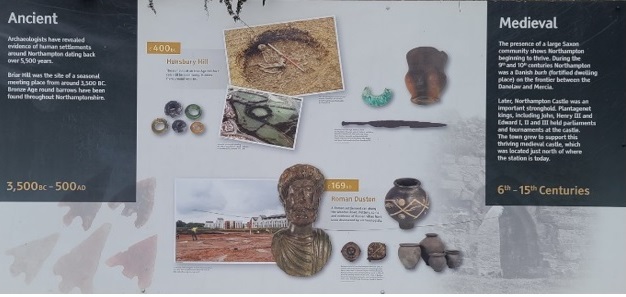
By depicting the murals through historical lenses, we can illuminate their evolution across social, cultural, economic, and political evolution in Britain, as well as their lasting effects on contemporary global dynamics. The wall features nine murals, each representing a distinct stage in a timeline that begins in 800 BCE.
Although I am interested in undertaking substantial research on these murals, my current focus is to analyse and evaluate one mural each month within its historical context. Through an examination of murals, artefacts, texts, and voices, I aim to explore the significant role that Northampton Castle, its surrounding areas, and local communities played in shaping English and British history during this pivotal period. By examining the intersections of art, architecture, technology, individuals, and historical events, I seek to illuminate the area’s legacy and situate its contributions to the national narrative within a broader historical context.
[1] Pevsner, Nikolaus; Cherry, Bridget (revision) (1961). The Buildings of England – Northamptonshire (London: Yale University Press), p. 328.
[2] ‘Castle Park Heritage Part 2: Anglo-Saxon Northampton’, West Northamptonshire Council <https://www.westnorthants.gov.uk/castle-park-heritage-timeline/castle-park-heritage-part-2-anglo-saxon-northampton> [Accessed 1st January 2026].
[3] Williams, JH., ‘From ‘palace’ to ‘town’: Northampton and urban origins’, Anglo-Saxon England (Cambridge University Press,1984), pp.113-136.<doi:10.1017/S0263675100003549>.
[4] Chapman, Andy, ‘Northampton Castle Part 1: Introduction, pre-castle archaeology, and the history and topography of the castle’, (2021), pp. 137-189. <https://www.researchgate.net/publication/373271969_Northampton_Castle_Part_1_Introduction_pre-castle_archaeology_and_the_history_and_topography_of_the_castle> [Accessed 1st January 2026].
[5] ‘Castle Park Heritage Part 11: The fall of the Castle walls’, West Northamptonshire Council <https://www.westnorthants.gov.uk/castle-park-heritage-timeline/castle-park-heritage-part-11-fall-castle-walls> [Accessed 1st January 2026].
[6] Maxine Berg, Luxury and Pleasure in Eighteenth-century Britain (Oxford: Oxford University Press, 2005), p. 3.
[7] Beckert, Sven, Empire of Cotton: A New History of Global Capitalism (London: Penguin Book, 2014), pp. 50-51.
[8] Hobsbawm, E. J., Industry and Empire (London: Penguin Books, 1968), p.34.